
Share
Global Economics in a Time of Conflict: What the Israel - Iran - US Tensions Really Mean
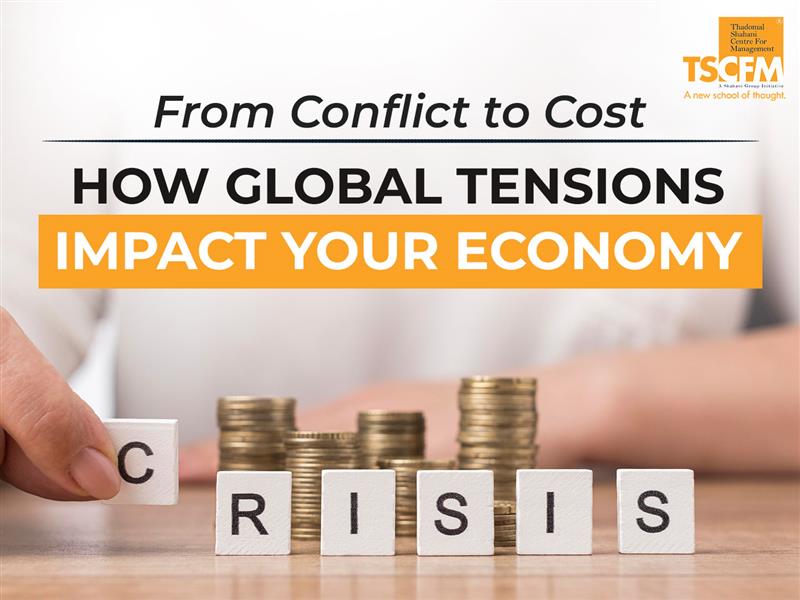
If you follow global news even casually, the tensions involving Iran, Israel, and the United States can feel distant, almost like something that belongs to diplomats and defence experts.
But step back for a moment and you will notice how quietly these events shape the economic environment all of us live and work in.
As management students and future decision makers, it helps to look at such situations not only as political developments, but as economic forces in motion.
Economics, at its simplest, is about movement. Movement of goods, capital, resources, and confidence. When conflict enters the picture, especially in a sensitive region like the Middle East, these movements get disturbed in ways that are not always immediately visible.
One of the first areas where this disturbance shows up is energy. A key route to keep in mind is the Strait of Hormuz. A large share of the world’s oil passes through this narrow stretch. Even a hint of disruption here can push oil prices upward.
Now think about what that means in practical terms. Oil is not just fuel for vehicles. It affects transportation, logistics, packaging, and manufacturing across industries. When prices rise, businesses start feeling the pressure quickly, and that pressure often finds its way to the end consumer.
For a country like India, which relies heavily on imported energy, this becomes a real concern. Inflation is no longer something you read about in a textbook. It shows up in operating costs, pricing decisions, and even everyday household expenses.
There is another layer to this that is easy to overlook. Modern businesses depend on complex supply chains that stretch across countries. When something shifts in one part of the world, the effects travel quietly but steadily.
Consider this simple example. A factory in Pune may not stop because of war, but because critical chemicals do not arrive on time. Or a Hari Om Sweets outlet may not shut due to conflict, but because commercial LPG supplies get disrupted. The connection is indirect, but the impact is real.
We also need to recognise that markets are not driven only by numbers. They are influenced by how people feel about the future. When uncertainty increases, investors become cautious, businesses delay expansion, and consumers start spending more carefully. This does not create an immediate collapse, but it gradually slows economic momentum.
This is why geopolitical tensions matter even when they do not directly involve your country. They shape expectations, and expectations shape decisions.
For those of you studying management, there are a few takeaways worth reflecting on. Risk today is not limited by geography. What seems far away can influence your costs, your supply chain, and your strategy. At the same time, flexibility is becoming just as important as efficiency. Organisations that depend too heavily on one source or one region often find themselves vulnerable.
It is also worth remembering that economics is not abstract. Behind every increase in cost or delay in supply, there are real people and real consequences.
What we are seeing today is a reminder that globalization brings both opportunity and exposure. It connects markets, but it also connects risks.
As future managers, your role will go beyond understanding financial statements or market trends. You will need to read the larger environment and respond with awareness and judgement.
Because in the end, economics is not separate from the world around us. It is simply a reflection of it.
Want a Successful Career?
Fill up this form for a free career psychometric test & a 30 min career guidance session with our advisor.
Categories
- Global MBA
- Business Management Program
- Banking and Finance
- Digital Marketing
- MBA for Working Professionals
- Business English
- Career Advice